



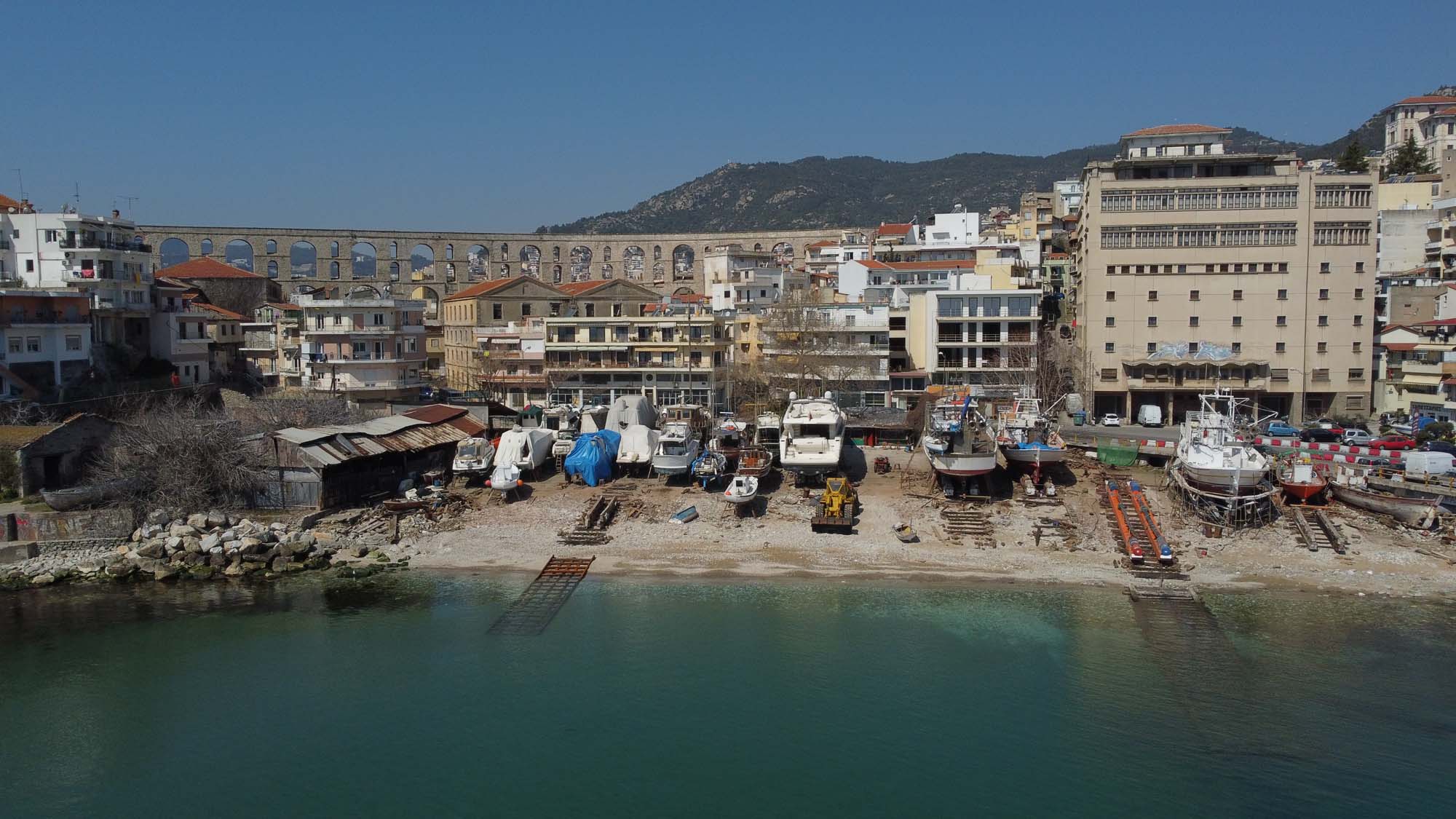
Kamares, Aqueduct
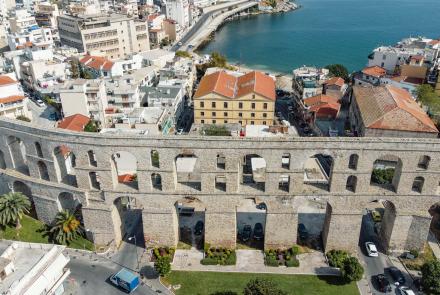
At the beginning of the 16th century, the arid peninsula of Panagia was supplied with water from the area of Palea Kavala. The water was brought to the city through a six and a half kilometre long underground pipeline that started at a spring 400 metres high (known as the 'Mother of Water' or 'Soubasi' or 'Three Karagatsi') and ended at Kamares. The most famous monument of Kavala has a length of 270 metres, a maximum height of 25 metres and it is built of local granite and bricks. It stands on 18 massive piers ('podarika') and has a double and in some places a triple series of arches. It was built to bridge the low part that separates the peninsula of Panagia from the opposite hills. This allowed water to reach the public fountains (the remains of three still exist), the reservoirs, the baths and the institutions of the old town. The Kamares were built by Ibrahim Pasha, vizier of Sultan Suleiman the Magnificent, between 1520 and 1530, during the reconstruction of the city, and were a vital project. The water made the settlement viable, contributed to the development of its urban functions, the settlement of new inhabitants and the great increase in its population. In short, it was a decisive factor in the transformation of Kavala from an insignificant settlement to a small town. As a project it is enormous, disproportionate to the size of the then insignificant settlement. A similar aqueduct from the Ottoman period, on such a scale and of such powerful construction, cannot be found elsewhere. It is therefore likely that there was an earlier aqueduct on the same site, on the remains of which the Kamares was built. A more convincing view is that the Kamares is the Roman aqueduct of ancient Neapolis. It was built in the early post-Christian centuries, between the 1st and 6th centuries, underwent many repairs from time to time and must have retained its original function at least until the Middle Byzantine period. Between 1520 and 1530, the water conduit was radically repaired along its entire route from the 'Three Karagatsia' to the city, the water bridges were built or repaired and the imposing arches were rebuilt in place of the damaged aqueduct. This old aqueduct supplied water to Kavala until the first decades of the 20th century. It was kept in good condition for four centuries thanks to continuous and systematic maintenance and occasional repairs. In 1912-1913, the authorities of the temporary Bulgarian administration abolished the centuries-old protective measures and turned the waterway into a road. The passage of pedestrians, herds and carts caused damage and ruptures in the canal, resulting in loss of water and frequent contamination. The city of Kavala faced a huge water supply problem during the years of refugee settlement. Its population grew from 25,000 to 50,000 and there was no internal water supply network. Water reached the old town only for a few hours each day, and the communal taps became the scene of Homeric squabbles over the scarce commodity. Thus, between 1914 and 1928, the city was tragically affected by the lack of water, which led to systematic efforts to solve the problem. In 1923 the engineer Nikolaos Michas was commissioned to carry out a water supply study and in 1928 the city's new aqueduct was built, drawing water from three new boreholes in the Tekir-Bunar area, drilled in 1927 near an existing one. This pre-existing borehole had been dug in 1911 as a gift from the Haddib of Egypt to his hometown to provide it with the necessary aqueduct. Water was pumped from this site by two diesel-powered pumps. In 1948, the Municipality of Kavala installed two electric pumping stations 150 metres away from the original pumping station. This greatly improved the situation. However, the water shortage was still severe. Between 1957 and 1958, the water level in the boreholes dropped. In order to raise the water level, the pumping station was frequently shut down. The municipality then drilled two new boreholes, which saved Kavala from a water shortage test in 1959-1960, when the automatic flow of borehole I was completely interrupted for almost the entire summer period. However, it was now well known that the water supply from the Tekir-Bunar was insufficient, especially during the summer months. Efforts were therefore made to find new water resources. In 1963, civil engineer L. Kortesis was commissioned to carry out a study. According to this study, two additional boreholes could be developed in the area of Amygdaleonas - Datos, a solution that was economically feasible and within the means of the Municipality of Kavala. It would also allow full use to be made of the existing plant, which had the significant advantage of high automatic flow. However, for reasons unknown, the project was not carried out and the problem of water shortage continued for some years. In 1968 a new attempt was made and the civil and hydraulic engineer Themistocles Xanthopoulos was commissioned to carry out a study for the construction of the external and internal network of Kavala. The main objectives of this study were to ensure the required quantity of water for at least the next 40 years and to ensure good quality water in the most economical way. After studying all the existing solutions, the Voirani spring solution was chosen as the most advantageous and efficient, and the 'Final Study of the Water Supply of the City of Kavala' was awarded to Th. Xanthopoulos and his team. Work began immediately and was completed in July 1973 with the inauguration of the new Central Water Supply Pump Station.