



Abdera Archaeological Site - Abdera the home of the philosophers (Democritus, Protagoras etc.)
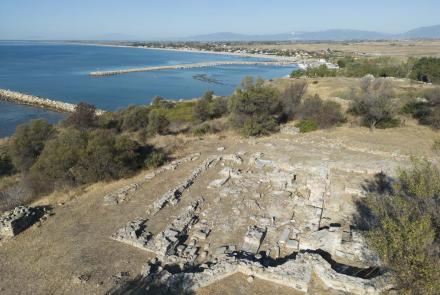
The archaeological site of Abdera, located on Bouloustra Cape, comprises the northern and southern enclosures, the acropolis of the ancient city, and its cemeteries, which primarily extend to the northwest, north, and northeast. These areas date back to the Archaic, Classical, and Hellenistic periods. Within the northern enclosure, visitors can find remnants of walls and single-room buildings from the earlier city of the Clazomenians from Asia Minor, dating to the 7th century BC. Additional features include sections of the walls built by the Teians in the 6th-5th century BC, a boathouse from the same period at the north-eastern edge of the harbour before it became landlocked due to sedimentation, and the ruins of a sanctuary dedicated to Demeter and Kore, dated to the 6th-4th century BC, along with a Hellenistic cemetery. The most extensively excavated and accessible part of the archaeological site lies near the modern harbour. This area includes the western section of the southern enclosure, where visitors can observe the western wall, a gate with towers, streets, and residential structures. Before entering the ancient city, visitors first encounter buildings from the Roman Imperial period, which do not adhere to the Hippodamian grid system. Nearby are the funerary basilica of the Christian cemetery of Polystylos and the ruins of a luxurious Roman bathhouse, notable for its elliptical hall and a staircase leading to the hypocaust. The visible residential structures in this area also belong to the Imperial period. Beyond the main accessible sections, additional excavated areas are scattered throughout the site, although none of these excavations are fully completed. At the southern edge of the site stands the acropolis of the ancient city, where only parts of the ancient walls remain. At the western edge, near the sea, the breakwater of the western harbour is visible, while the city’s second harbour, the eastern one, lies on the north-eastern side of the southern enclosure, with its breakwater and storage facilities also discernible. While the ancient city’s layout is relatively well-preserved, especially regarding private residences, shops, walls, and the Byzantine Polystylos tombs, no public buildings have been identified. The only known public structure is the theatre, situated between the northern and southern enclosures on the slope of a hill. However, the theatre is heavily damaged and not accessible to visitors. Visits to the site can be arranged during working hours on weekdays, subject to prior scheduling.